

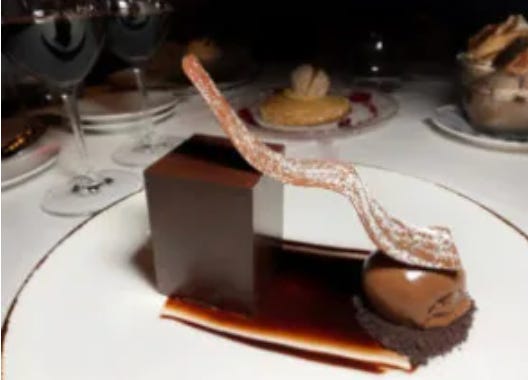
“The restaurant's signature dessert, the admittedly ridiculous Park Avenue Park Bench, really does succeed as theater. With its chocolate slatted bench and leaning lamppost topped by a white chocolate globe, it exudes a strange, twilight melancholy. You almost expect a four-inch Frank Sinatra to stroll over, take a seat and start crooning.” ~ William Grimes, NY Times July 18, 2001

In a long career of writing just about anything for money, I was once hired to ghostwrite the recollections of Senator Ted Kennedy’s personal chef in Hyannis for a coffee table cookbook.
The chef had an illustrious collection of stories involving cooking and baking for the Kennedys, but he was a better cook than a raconteur. It was my job to translate his star-studded tales into heartwarming, high gloss anecdotes that were layered into the book between recipes and color photos of the food and the family.
Someone hearing the story years later asked if I had made many of the recipes in the book – and I was genuinely startled. It had never so much as crossed my mind to make a single one of them. It’s not only that, like the Jewish American Princess in the joke, I prefer to make reservations for dinner, but that I’m allergic to or uninterested in most of the food in that cookbook and in most others. I lean vegetarian, and a have long list of foods I can’t eat for health reasons. But growing up on the outer edges of the Upper East Side, in the era of early Mad Men – the 1960s, in the Sixties around First Avenue – offered essential early lessons in dining. As a kid, I was hyper-aware of where my parents, newcomers to the city, and their much tonier friends went for dinner.
It was a time when the Upper East Side was le plus chic – maybe the only chic – part of the city. The names of their destinations vibrate like the songs of one’s youth. The Sign of the Dove. The Palm. The Brasserie. The 21 Club. The Rainbow Grill. The Rainbow Room. And the ultra-Mad Men hangout – a reference that never comes up in the TV show, to my knowledge – P.J. Clarke’s, a famous old saloon with a tin ceiling on the corner of 55th and Third whose Waspy, Mad Men patrons were crisply dressed, chronically lubricated, and happy to soak up the booze with hamburgers and chili served on red-and-white-checked tablecloths that have a Madeline-like effect on me. PJ’s and the Brasserie were the two restaurants I was taken to, though there was much talk about the others and the occasional doggie bag as show and tell, including a gigantic lobster claw from the Palm. As a family, we were regulars at the modest neighborhood Chinese (spare ribs, lobster Cantonese, eggs rolls) and a dark, cramped Italian place (veal parmesan; spaghetti carbonara) on the corner of 72nd Street and Second.
We had been introduced to P.J. Clarke’s by the glamorous couple who lived downstairs from us. They deigned to hang out with my much less glamorous and affluent parents because their son was my friend, and because the booze flowed so freely. It was as though we lived in a dorm or a sitcom, the doors between our apartments were so often open to each other’s families. And because of that, my mother used what power she had to move to another building a short time later, to escape their besotted influence. But the damage had already been done: I adored P.J. Clarke’s, and I understood that restaurants were places you could spend a few carefree hours being waited on and blotting out troubles of all kinds.
A happy tradition arose in our fragile family. For a child’s birthday, we could pick out a “fancy” restaurant and a Broadway show. I can’t remember many of these choices, but I have a lovely memory of a glamorous Spanish restaurant in the Time-Life Building, La Fonda del Sol, followed by a revival of an Arthur Miller play. I seem to recall All My Sons but it might have been Death of a Salesman. When I was a young teenager, my parents hung out a bar-restaurant in the style of PJ Clarke’s on 83rd and Third called Martell’s, and I went there often with them and sometimes by myself, because I had a crush on one of the waiters, who was a descendent of Louisa May Alcott and a student of philosophy at Columbia. It might have been this crush that led me to Morningside Heights as a teenager, where I was bedazzled by the cheap, ethnic restaurants that lined that stretch of Broadway: Szechuan, Indian, Greek, Cuban-Chinese, holes in the walls whose tables were filled with young men who resembled the waiter I had the crush on. The décor in these places was downscale, the food was full of hot chili peppers, cardamom, and tamarind, and the allure was indisputable. It was 1969 or ’70 or ’71 – or it was all three – and I was drawn, moth to flame, to this neighborhood, these restaurants, these flavors.
It was fitting, I suppose, that one of the last echt East Side gatherings of my young life was an awkward celebratory lunch that my recently separated parents sprung for at the posh Le Perigord Park, at 63rd and Park – our first and last visit there. I remember nothing except that we sat miserably around a table in a formal dining room with two walls of high windows overlooking both Park and 63rd Street, doing our best to go through the motions of celebrating amidst the strain of a looming divorce and more financial upheaval. The food must have been the French fare of the day – what else would have been on the menu back then? Perhaps boeuf bourguignon, coq au vin, maybe French onion soup served in a hot bowl encrusted with gruyere cheese that had been baked on and needed to be pried off like bark. Foodwise and every-other-wise, I was already out the door – about to go to college across town, in the shadow of all those hole-in-the-wall eateries.
I lived in many parts of the country after college before returning to New York, but the Upper West Side ethos – the ethnic food, the bohemian appetites and attitudes – defined me culturally and culinarily. Not so parenthetically, I got married in 1987 and divorced in 1996, and soon moved back to New York City. Though downtown was the place to be by then, I returned to the Upper West Side. These were my people, my restaurants, my shopping bags of grilled chicken and grilled salmon from Zabar’s. I was virtually an Ed Koren cartoon character of an Upper West Sider: bookish, inelegant, over-therapized, a wearer of clogs and Birkenstocks.
One evening, I went on a date with a man I didn’t know well who invited me to an unlikely place for a Koren cartoon character, one I hadn’t heard of, as I’d only been back in the city a short time. The Park Avenue Café, at 63rd and Park. Moi? Really? Of course I wondered if it occupied the same space as Le Perigord Park.
It did indeed but had an entirely different vibe. Vieux French had given way to New American, to go with the food. The décor – the vast room with its high ceilings and the same towering walls of high windows – resembled, said The New York Times, “a Cracker Barrel made over by Martha Stewart.” The Times reviewer went on to say, “Fun American folk art enlivens the interior; green checkerboard upholstery and napkins send a wholesome message; and the hapless waiters wear silly ties with a hideous American flag pattern…. While the rest of Manhattan sweats day and night honing its hip edge, the Park Avenue Café sails on … in the opposite direction.”
To be sure, it wasn’t hip – but neither was I. Yet it was the opposite of stodgy. The décor was playful, the waiters were relaxed, the well-lit, crowded main room buzzed with lively conversation. There was an assortment of tables, booths and banquettes, so there were parties of four and eight and well-heeled singles who looked like they were neighborhood regulars, eating happily at the usual banquette in the corner. And now and then, once or twice a year over a period of ten years, on “special occasions” when I could splurge or it was Restaurant Week, I could be spotted at one of the tables with a friend or family member, or two or three.
The draw for me was as much the atmosphere as the food, particularly since they did a few wonderful things with vegetables. Again, the Times’, which reviewed the restaurant on a good number of occasions: “The chef, David Burke, is famous for the way he plays with food. Almost every dish on this American menu has a sly twist. The swordfish chop, like the duck at Tour d’Argent in Paris, comes with a numbered certificate, and you never know what you’ll find in the adorable bread basket.” On my plate would always be either the fresh vegetable platter or Mrs. Asher’s vegetable torte. It looked like a small cake made of delicate layers of many vegetables and something exquisite that held it together – and a side of sautéed wild mushrooms. And dessert – yes, there was the Park Avenue Park Bench – but at my table there was almost always the other signature dessert, the Cube: a perfectly smooth, dark chocolate cube four or five inches high, three or four wide, filled, beneath the paper thin dark chocolate, with espresso mousse. The Cube is a hard act to follow, but so are the stories of the place that knock around in my memory. In August 1999, I had a date coming up – a man who lived in Boston whom I had just met on the Internet. There was a ton of chemistry between us, and he was coming to New York to see if it held up in real life. When he told me to pick out a restaurant. I called my sister, who knew the scene better than I did.
“What do you think?” I asked. “Should I take him to the Park Avenue Café?” A long pause. She was mulling over the options, the expectations of the event.
“I’d go down a notch,” she said finally, dead serious.
I knew exactly what she meant. If we had a pricey dinner, and the chemistry fizzled, there would just be this hefty restaurant bill between us that either he’d have to pay or we would split, but in either case, the large expenditure – and the awkwardness around it – would call too much attention to the absence of sentiment. Instead, for our first date, we went to Gigino Trattoria on Greenwich Street – and for a drink afterwards down the street and up a fast-moving elevator to Windows on the World.
I didn’t tell him for a long while about the calculation my sister made and I went along with – I’d go down a notch – but telling the story never fails to make us smile almost two decades later. It’s a reminder that restaurants are signifiers, information, evidence, status, affectation, affection, homes away from home, places where we might define ourselves or escape ourselves, come together, or fall apart. Over dinner at the Autopub, a gimmick restaurant that was in the original basement of the GM building on 59th and Fifth Avenue—where the Apple Store now resides -- my mother told my father that he could leave the marriage, and she would be all right. At the Café Loup, I had my last encounter with a childhood best friend, quarreling over a check. When I took a friend from London to the Park Avenue Cafe – surely a special occasion because I had only ever seen her in London – she looked at me suspiciously as we sat down in this exceeding fancy setting. It was more upscale than it had been, with new upholstery on the chairs and a more elegant look.
“Do you come here often?” she asked. I could hear that what she meant was, “Is this who you really are – and not the person I’ve known for twenty years who prefers Indian take-away from the greasy spoon down the street?”
“Not often,” I said, “but I’ve been here many times.”
The last time was in November 2007. It was a significant birthday for my husband, and his staff had asked what they should get him. I suggested a gift certificate to our favorite restaurant. But we were baffled when we arrived. It was called Park Avenue Autumn, and the décor and menu were utterly different. The restaurant had essentially vanished. As we sat down at the table in a radically altered dining room, I asked the waiter what had happened. Smith & Wollensky, the restaurant group that owned the place, had done a total makeover. He explained that the restaurant would change its menu and décor and name for each new season – and here we were in fall, at Park Avenue Autumn, feeling more than a little autumnal. The grand room was gloomy, stuffy, and absurdly pretentious. The food was dull, the atmosphere duller. Was it more like Park Avenue itself now? Maybe that was the problem.
I never went back. Over the years I have infrequently passed by the canopy – the ever-changing canopies, whether they say Park Avenue Spring, Summer, Fall, or Winter – and winced. It was as though a love affair had taken place inside. Or the place itself was the love affair – and I’d been betrayed. At one dinner with my favorite cousins and my sister, she recognized the waiter from a comedy improv class she’d taken, and they bantered about the rules of improv. “Never say no to any offer,” he said, “or the skit is over.”
I wish I could remember more of the rules, more of the banter. It may be enough to remember the Park Avenue Park Bench arriving on the table to be shared, the sheer joy of it, the nerve, the care the pastry chef had taken, the rich, dark chocolate, the exquisite melancholy.
~~~~~~~~~
Oh, yeah! This was a great read--and reminded me of the UES places that I mostly walked by in the early 80's--I was a clerical worker for National Geographhic at the Exxon building on 6th and 50th so I didn't make a whole lot of money. But food memoirs are luscious--and I'm thinking not just of MFK Fisher, but of the wonderful memoir by James Beard, Delights and Prejudices.
I absolutely love this post--and the new platform! My mind is now reeling with the many restaurants (and bars) that have been meaningful in my life.